
Wondering how to increase VO2 max? This article covers effective training methods, measurement techniques, and essential tips to help you improve your VO2 max and boost your performance.
Key Takeaways
- VO2 max is a crucial indicator of cardiovascular fitness, affecting athletic performance and overall health
- High-intensity interval training (HIIT) is one of the most effective method for improving VO2 max
- Effective training involves varied intensities, adequate recovery, and consistent effort over time
- Age and genetics influence VO2 max, but training can still produce significant improvements
Understanding VO2 Max
VO2 max, the maximum volume of oxygen consumed during intense exercise, is a cornerstone of cardiovascular fitness.
Expressed in milliliters of oxygen per kilogram of body weight per minute (mL/kg/min), it tells us how much oxygen our bodies can utilize during peak physical exertion.
A high VO2 max level is a hallmark of efficient heart, lungs, and muscle function.
Higher VO2 max levels are associated with improved efficiency in physical performance and better health outcomes.
The heart, lungs, and muscles work in harmony to use more oxygen, allowing you to train harder and recover faster.
Improving your VO2 max isn't just about better fitness. It's an investment in your long-term health and well-being. Whether you're chasing PRs or simply want to improve your cardiovascular health, understanding and working on your VO2 max pays dividends.
How to Measure VO2 Max
There are several methods to measure VO2 max, ranging from advanced laboratory tests to simpler field tests.
The most reliable method involves a graded exercise test on a treadmill, where your oxygen consumption is measured during progressively intense exercise.
For those who don't have access to a lab, field tests like the Cooper test (running as far as possible in 12 minutes) offer practical alternatives. These aren't as accurate, but they give you a reasonable estimate.
In recent years, technology has made it easier to estimate VO2 max using GPS watches and heart rate monitors. I use a Coros Pace 2, which provides VO2 max estimates based on heart rate and pace data during runs. Devices like Garmin watches use similar algorithms.
The accuracy of these portable devices can vary.
Recording multiple workouts improves the precision of the estimates. While not perfect, these tools let you track trends over time without needing specialized equipment.
Key Factors Influencing VO2 Max
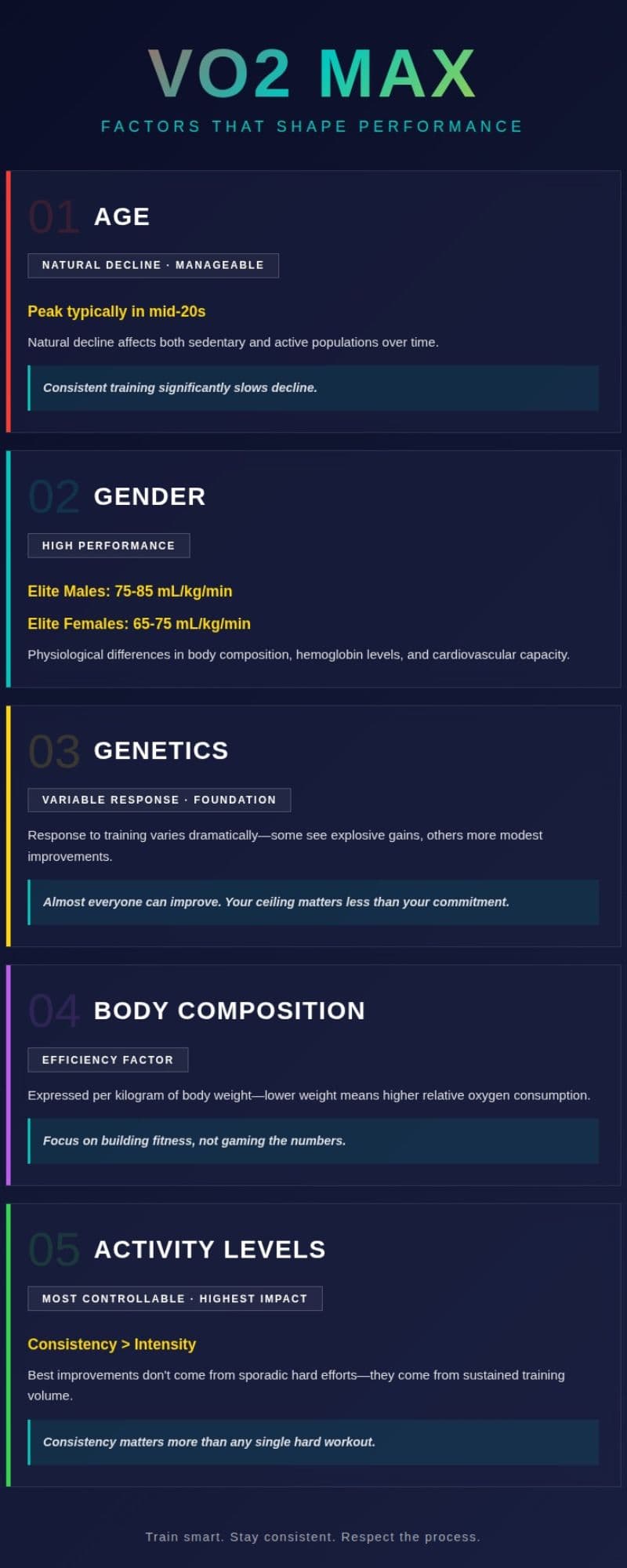
Several key factors influence VO2 max:
Age: Research published in Circulation shows that VO2 max peaks between ages 15-30 and then declines at a rate of approximately 8-10% per decade in both sedentary and athletic populations [1]. I'm 36 now, so I'm theoretically past my absolute peak. However, consistent training can significantly slow this decline.
Gender: Men generally have higher VO2 max levels compared to women, partly due to differences in body composition and cardiovascular capacity. Elite male distance runners typically have VO2 max values of 75-85 mL/kg/min, while elite females are typically 65-75 mL/kg/min.
Genetics: Genetics play a significant role in determining an individual's potential for improving VO2 max through exercise training. Some people respond dramatically to training, while others see more modest gains. But here's the key: almost everyone can improve with proper training.
Body Composition: Body weight and composition can influence VO2 max measurements. Since it's expressed per kilogram of body weight, excess body fat potentially decreases overall efficiency. However, don't chase weight loss just to improve the math. Focus on building fitness.
Activity Levels: Consistent exercise is crucial for optimizing VO2 max. I've learned that consistency matters more than any single hard workout. My best VO2 max improvements came during periods when I was running 70-80 miles per week consistently, not when I was doing sporadic hard efforts.
Understanding these influencing factors helps tailor your training program to maximize improvements. By focusing on consistent exercise and addressing controllable factors like body composition and activity levels, you can significantly enhance your VO2 max and overall fitness level.
Effective Training Routines to Improve VO2 Max

To improve VO2 max, it's essential to incorporate varied training routines that challenge your cardiovascular system.
Understanding the different types of runs and their purposes helps you structure an effective program.
Regular physical activity is crucial, but the intensity and type of exercise you perform can significantly impact your VO2 max improvements.
Three effective training approaches can significantly enhance your VO2 max: High-Intensity Interval Training (HIIT), steady pace aerobic activity, and incorporating proper recovery periods.
High-Intensity Interval Training (HIIT)
A study in Medicine and Science in Sports and Exercise compared different training intensities and found that high-intensity interval training resulted in significantly increased VO2 max compared with long slow distance and lactate-threshold training intensities, with improvements of 5.5% and 7.2% respectively for different interval protocols [2].
High-Intensity Interval Training (HIIT) involves short bursts of very hard effort followed by recovery periods. This training is highly effective for improving VO2 max because it challenges your body to work at maximum oxygen uptake capacity.
For VO2 max intervals, I typically aim for 90-95% of my maximum heart rate. This is hard effort that you can sustain for 3-5 minutes at a time, but it's not an all-out sprint.
A meta-analysis in the Journal of Science and Medicine in Sport found that while short-term, low-volume HIIT is effective, long-term training (4-12 weeks) with higher volume displayed significantly larger effects on VO2 max [3].
Example VO2 Max Workouts I Use:
4 x 4 minutes: Four-minute intervals, with three-minute recovery jogs. This is a classic workout. Here's data from a recent session:
- Intervals run at 4:50-5:00 per mile pace
- Recovery jogs at 8:00 pace
10 x 1 minute: Shorter, harder efforts. One minute at 5k pace or faster, with equal rest. This format accumulates significant time at high intensity without the mental burden of long intervals.
The key is choosing exercises you enjoy. If you hate running intervals, try cycling or rowing.
I use various interval formats depending on the training phase, from 10 x 1 minute efforts to longer 4-minute intervals.
Different speed workouts for distance runners work for different goals and fitness levels. Engagement and consistency are crucial for sustained VO2 max improvements.
Steady Pace Aerobic Activity
Steady pace aerobic activities, such as easy runs and long runs, are essential for building a strong cardiovascular foundation. These moderate to easy intensity exercises contribute to cardiovascular health and improve your aerobic capacity over time.
Easy runs form the base of my training. Building your aerobic base through consistent easy mileage is what allows the hard workouts to be truly effective. When I'm running 75-80 miles per week, probably 60-65 of those miles are at easy pace (heart rate below 140 bpm for me, roughly 60-70% of max heart rate). These runs:
- Build aerobic capacity
- Improve running economy
- Allow recovery between hard sessions
- Are less taxing on the body, allowing for longer exercise durations
The goal is to keep a consistent exercise intensity that challenges your cardiovascular system without overstraining it.
Incorporating Recovery Periods
Recovery periods in your training routine are essential for VO2 max improvement. Adequate rest lets your body adapt and recover, preventing overtraining and injuries.
This is where I've made mistakes. After that 28.3-mile run at 6:46 pace, I didn't recover properly. I jumped back into hard training too quickly, added aggressive hill work, and developed Achilles tendinopathy that sidelined me for four weeks. The lesson: VO2 max gains occur during rest, not during exertion.
My Current Recovery Approach:
- At least one complete rest day per week
- Easy runs the day after hard VO2 max sessions
- No back-to-back hard workouts
- Listening to my body, especially resting heart rate and how I feel during warm-ups
Insufficient recovery hinders progress. Your body needs time to rebuild and adapt to the training stress you've applied.
Monitoring Progress with Heart Rate Monitors
Heart rate monitors are essential tools for tracking exercise intensity and ensuring your workouts align with your goals for enhancing aerobic capacity. Heart rate data helps determine if your workouts are effectively improving VO2 max.
I use a Coros heart rate strap for my hard workouts. The data is invaluable:
During VO2 Max Intervals:
- Target: 175-188 bpm
- Recovery: drops to 140-150 bpm during rest periods
Tracking Trends: Regular monitoring of heart rate trends helps track fitness improvements and guides necessary adjustments to your training routine.
After a recent 6 x 1km threshold session (splits: 3:03, 2:58, 3:05, 2:59, 3:03) That consistency indicates good fitness and proper pacing. When fitness is improving, you'll notice your heart rate stabilizes more quickly after hard efforts.
Using a heart rate monitor during both high-intensity workouts and steady pace activities yields the most accurate results and helps you stay on track.
Nutrition and Hydration for Optimal Performance
Proper nutrition is vital to fuel the body during high-intensity workouts and promote recovery. A balanced diet rich in carbohydrates, proteins, and healthy fats contributes to overall cardiovascular health and supports better fitness.
I don't obsess over nutrition, but I've learned a few key principles:
Pre-Workout: Light carbohydrates 2-3 hours before hard sessions. A banana or toast with honey works well for me.
During Workouts: For sessions under 90 minutes, water is usually sufficient. Longer runs require carbohydrate intake.
Post-Workout: The recovery window matters. I aim for a mix of carbohydrates and protein within an hour of finishing hard efforts. Chocolate milk is surprisingly effective.
Hydration: Staying well-hydrated is equally important. Even slight dehydration can hinder performance and recovery, affecting blood flow to muscles. I aim for consistent hydration throughout the day rather than trying to "catch up" before workouts.
Focusing on nutrition and hydration supports your training routine and peak performance. You can't out-train a poor diet.
The Role of Genetics in VO2 Max Potential
Genetics play a significant role in determining VO2 max potential and how individuals respond to training. While genetic factors influence the rate of VO2 max improvements, consistent exercise remains the primary driver of enhancement.
Some people are genetic lottery winners when it comes to endurance. But almost anyone can improve their VO2 max with regular training, adequate recovery, and sufficient sleep.
I don't know my specific genetic predisposition for VO2 max, but I do know this: through consistent training, I've improved from an estimated 58 mL/kg/min to the mid-60s. That's meaningful progress regardless of genetic ceiling.
Research in Applied Physiology, Nutrition, and Metabolism indicates that reductions in muscle oxygen delivery, principally due to reduced cardiac output, play a dominant role up until late middle age, while skeletal muscle oxidative capacity decline becomes more important in extreme old age [4]. This suggests that targeted training can address different aspects of VO2 max depending on age.
Even experienced athletes may encounter a plateau in VO2 max after several years of training. I've noticed that improvements come slower now than when I first started running seriously. But they still come.
Common Mistakes and How to Avoid Them
Inadequate Recovery Time: One of the biggest mistakes in training routines is insufficient recovery between hard workouts. This impedes improvements in VO2 max and increases injury risk. I learned this lesson the hard way with my Achilles issue.
Too Many Hard Days: Some runners think more intensity equals more improvement. Not true. I do two hard sessions per week maximum, sometimes just one during heavy mileage phases. The rest are easy or moderate.
Ignoring the Aerobic Base: Jumping straight into high-intensity training without building an aerobic base is counterproductive. You need that foundation of easy mileage first.
Unrealistic Expectations: Maintaining peak VO2 max performance year-round is unrealistic. Fitness fluctuates. I peak for specific races, then allow periods of easier training. That's normal and healthy.
Not Enough Variety: Doing the same VO2 max workout every week leads to stagnation. I rotate between 1-minute intervals, 4-minute intervals, and longer tempo efforts to provide different stimuli.
By avoiding these common pitfalls, you can efficiently improve your VO2 max and overall fitness.
My Experience: What Actually Works
Over the past few years of focused VO2 max training, here's what I've learned:
Consistency Matters Most: The biggest improvements came when I maintained 70-80 mile weeks for months at a time, not from individual heroic workouts.
Quality Over Quantity: Two properly executed VO2 max sessions per week beat three mediocre ones. I schedule mine carefully, typically Tuesday (intervals) and Thursday or Friday (tempo or threshold).
Mix Intensities: My best training blocks included:
- 60-65 miles easy running
- One VO2 max session (intervals at 90-95% max HR)
- One threshold session (sustained effort at 85-88% max HR)
- One long run (90-120 minutes)
Recovery Is Non-Negotiable: After my Achilles injury from inadequate recovery, I take rest seriously. One complete rest day per week minimum, easy days truly easy (HR under 140).
Track Your Data: Using my Coros watch, I can see trends over months. When my VO2 max estimate climbs from 62 to 64 mL/kg/min over a training block, I know the work is paying off.
Real Results: The biggest improvements came when I maintained consistent training with proper structure. Learning to become a faster runner isn't just about running harder, it's about running smarter. Since focusing on systematic VO2 max training:
- 15:09 5k (down from 15:45)
- 31:10 10k (down from 32:15)
- 1:09 half marathon
- Multiple half marathon wins
The improvements are real and measurable.
Summary
Improving your VO2 max is a multifaceted journey that involves understanding its significance, measuring progress, and employing effective training routines. By focusing on high-intensity interval training, steady pace aerobic activity, and proper recovery, you can significantly enhance your cardiovascular fitness.
The research is clear: HIIT works, but it must be balanced with aerobic base building and adequate recovery. Remember to monitor your progress with heart rate data, maintain proper nutrition and hydration, and be mindful of genetic factors and common mistakes.
With dedication and consistency, you can unlock your full potential and achieve peak performance. For most runners, improvements of 5-15% over several months of focused training are realistic. Some will see more, some less, but almost everyone improves.
The key is playing the long game. Build your base, add intensity strategically, recover properly, and stay consistent.
Frequently Asked Questions
What is VO2 max and why is it important?
VO2 max is the maximum amount of oxygen your body can utilize during intense exercise. It's a key indicator of cardiovascular fitness and correlates with both athletic performance and overall health. Higher values generally indicate better endurance capacity and lower disease risk.
How can I measure my VO2 max?
You can estimate VO2 max using GPS watches with heart rate monitors (like Garmin or Coros), or by conducting field tests such as running as far as possible in 12 minutes. While less accurate than lab testing, these methods provide useful estimates for tracking trends over time.
Why is recovery important in a training routine?
Recovery is when your body adapts and improves. Training provides the stimulus, but adaptation happens during rest. Without adequate recovery, you risk overtraining, injury, and stagnation.
References
[1] Fletcher, G. F., Balady, G. J., Amsterdam, E. A., Chaitman, B., Eckel, R., Fleg, J., ... & Bazzarre, P. (2001). "Exercise standards for testing and training: a statement for healthcare professionals from the American Heart Association." Circulation, 104(14), 1694-1740. https://www.ahajournals.org/doi/full/10.1161/hc3901.095960
[2] Helgerud, J., Høydal, K., Wang, E., Karlsen, T., Berg, P., Bjerkaas, M., Simonsen, T., Helgesen, C., Hjorth, N., Bach, R., & Hoff, J. (2007). "Aerobic high-intensity intervals improve VO2max more than moderate training." Medicine and Science in Sports and Exercise, 39(4), 665-671. https://pubmed.ncbi.nlm.nih.gov/17414804/
[3] Cao, M., Quan, M., & Zhuang, J. (2019). "Effects of different protocols of high intensity interval training for VO2max improvements in adults: A meta-analysis of randomised controlled trials." Journal of Science and Medicine in Sport, 22(8), 941-947. https://pubmed.ncbi.nlm.nih.gov/30733142/
[4] Betik, A. C., & Hepple, R. T. (2008). "Determinants of VO2 max decline with aging: an integrated perspective." Applied Physiology, Nutrition, and Metabolism, 33(1), 130-140. https://pubmed.ncbi.nlm.nih.gov/18347663/
